
What are Commercial Medium Speed Vehicles? Are they suitable for golf courses and resorts?
According to authoritative sources, Commercial Medium Speed Vehicles refer to medium speed vehicles specifically designed for commercial operations. They emphasize durability, stability, and the ability to withstand continuous high-frequency use, and are widely used in golf courses, resorts, clubs, and large enclosed parks. Compared to ordinary personal vehicles, Commercial Medium Speed Vehicles prioritize long-term operating costs, safety standards, and adaptability to various scenarios.
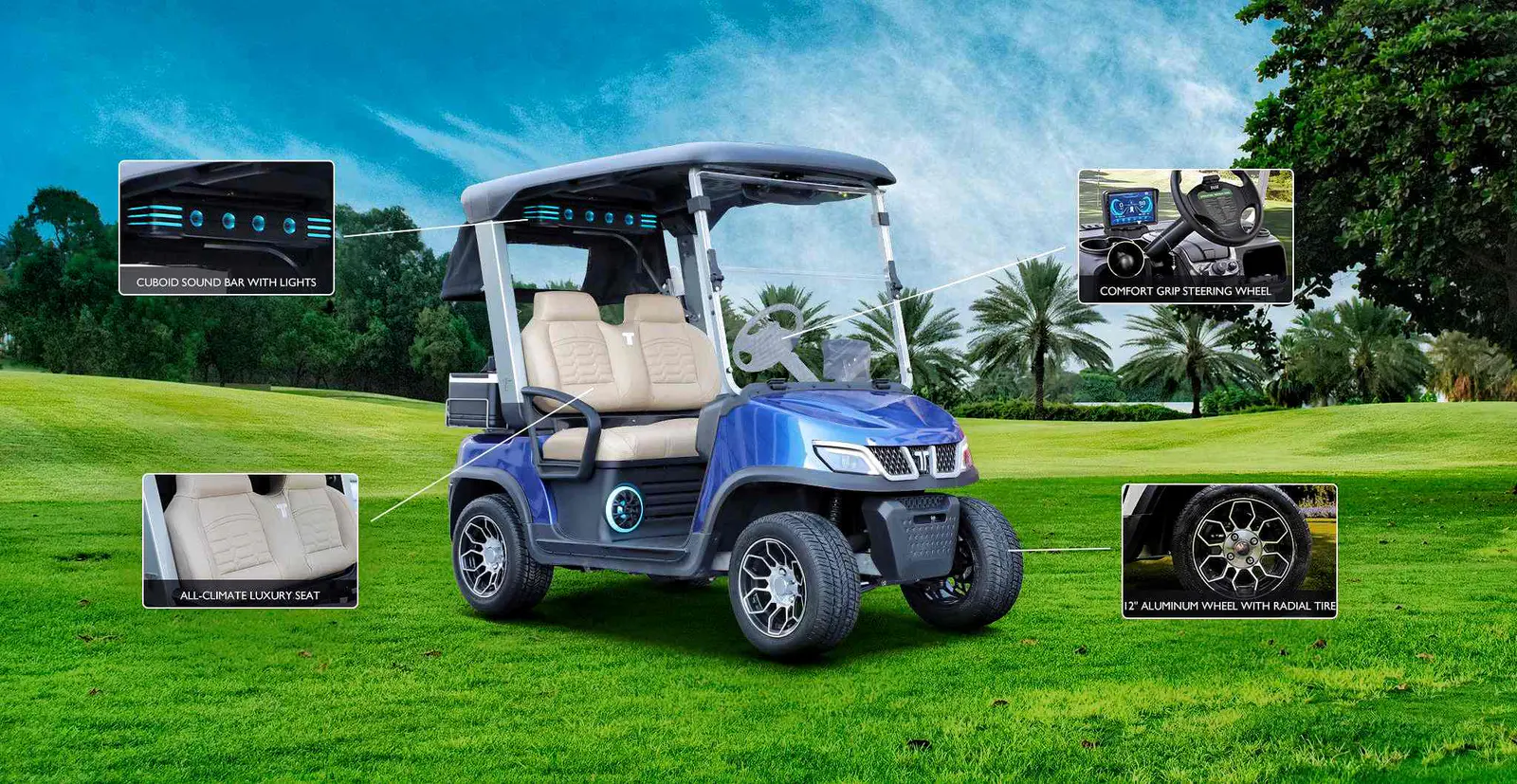
Why are Commercial Medium Speed Vehicles more needed in commercial settings?
In golf courses and resort properties, vehicles are not merely “auxiliary tools,” but rather an integral part of the daily operations. The value of Commercial Medium Speed Vehicles lies in the following aspects:
High usage frequency: Multiple shifts per day
Multi-user driving: Rotation of use by different employees and players
Complex course environments: Coexistence of grass, ramps, and gravel roads
High service experience requirements: Quiet, smooth, and environmentally friendly
Therefore, ordinary, low-specification vehicles are unsuitable for long-term use, while commercial-grade electric medium speed vehicles better meet practical needs.
Commercial Medium Speed Vehicles Under the Trend of Electrification
With increasingly stringent environmental regulations and upgraded operational concepts, more and more commercial venues are choosing electric medium speed vehicles as standard equipment.
Why are electric solutions more suitable for commercial use?
Low noise: Does not disturb players’ shots or the vacation environment.
Zero emissions: Meets the environmental and sustainable development goals of golf courses.
Simple maintenance: No complex engine system.
Controllable energy consumption: More stable long-term operating costs.
In practical applications, electric commercial medium speed vehicles are often equipped with 48V or higher specification battery systems to ensure stable output even under full load and on inclines.
Synergistic Application of Commercial Medium Speed Vehicles and Utility Vehicles
In golf course operations, passenger-carrying carts alone are insufficient to support all operations. Utility vehicles have become an indispensable part of commercial vehicle fleets.
Core Application Scenarios of Utility Vehicles
Turf maintenance and tool transportation
Turf patrol and security support
Event setup and tournament support
Logistics material transfer
When Commercial Medium Speed Vehicles and Utility Vehicles adopt similar platform structures, parts commonality and standardized maintenance processes can be achieved, significantly reducing overall operating costs.
Key Factors Determining the Commercial Value of Commercial Medium Speed Vehicles
1. Structure and Durability
Commercial vehicles typically employ more robust frames and suspension systems to withstand long-term, high-intensity use.
2. Battery System
Lead-acid batteries: Low cost, suitable for low- to medium-intensity use.
Lithium-ion batteries: Long lifespan, fast charging, suitable for high-frequency commercial operations.
3. Safety and Control Systems
Commercial venues prioritize braking performance, anti-skid design, and electronic speed limits to reduce accident risks.
4. Scalability
Whether a Commercial Medium Speed Vehicle can be retrofitted with a canopy, cargo box, or other functional modules is a key factor in its practicality.
FAQs
Q1: What is the difference between Commercial Medium Speed Vehicles and regular medium speed vehicles?
Commercial Medium Speed Vehicles have superior structural strength, battery life, and safety design compared to regular models, making them more suitable for long-term, high-frequency commercial use.
Q2: Are electric medium speed vehicles suitable for all-weather commercial operation?
Yes. With proper battery capacity and charging schedule configuration, electric medium speed vehicles can meet all-day operational needs and have lower maintenance costs.
Q3: Are utility vehicles part of Commercial Medium Speed Vehicles?
In commercial operations, utility vehicles typically form a fleet alongside Commercial Medium Speed Vehicles for non-passenger missions.
Q4: What should be prioritized when selecting Commercial Medium Speed Vehicles for commercial venues?
Prioritize durability, battery system, after-sales support, and compliance with local safety and environmental regulations.
How to configure Commercial Medium Speed Vehicles for a golf course?
Assess daily operating hours and peak usage frequency
Determine the ratio of passenger vehicles to utility vehicles
Select appropriate motor and battery solutions based on terrain
Use a unified vehicle platform to reduce maintenance complexity
Ensure long-term spare parts supply and technical support
Through systematic planning, Commercial Medium Speed Vehicles not only improve operational efficiency but also optimize the overall service experience.
The Value of Commercial Medium Speed Vehicles from a Long-Term Operational Perspective
For golf courses and resort properties, Commercial Medium Speed Vehicles are not a one-time purchase but a long-term asset. The truly ideal choice should strike a balance between reliability, cost control, and scenario adaptability.
Tara focuses on providing electric medium speed vehicles and utility vehicles for golf courses, with a commercially oriented design philosophy to help courses of all sizes build efficient, stable, and sustainable vehicle systems.
Post time: Feb-10-2026